Rock Mantis and What Outward 2 Should Learn from Its Best Enemy Design
Rock Mantis and What Outward 2 Should Learn from Its Best Enemy Design
Outward has always been a game that asks more of its players than most RPGs are comfortable with. No quest markers pointing you to objectives. No safety net if you die in the wrong place. And a combat system that punishes button mashing just as hard as it rewards patience and read-on-attack timing. Within that framework, the Rock Mantis stands out as one of the most well-realized enemy designs in the game — and a Reddit thread from the community this week makes a compelling case for why Outward 2 should take notes.
Why the Rock Mantis Works
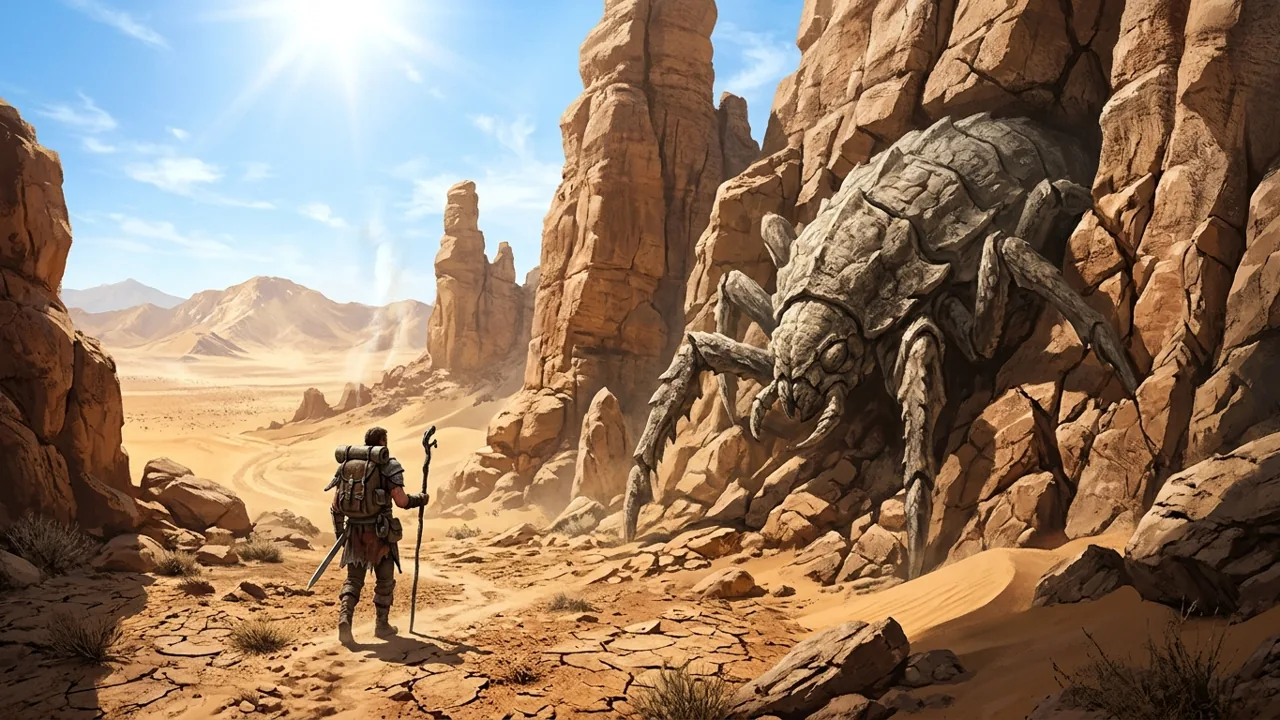
Most enemies in Outward telegraph their presence clearly. You can spot a Bandit from across a field, pick out a Hyena by its movement pattern, or hear a Horror before you see it. The Rock Mantis does none of that. In the Abrassar desert, its granite-grey carapace blends almost perfectly with the rocky terrain. Players regularly walk within weapon range before realizing there's anything there. That's not a cheap trick — it's environmental design doing real work, turning the act of moving through the world into something that demands attention.
Once you're in combat with one, the Rock Mantis continues to earn its reputation. According to community analysis, it may be the only enemy in Outward whose entire moveset can be consistently sidestepped without rolling. That alone would make it unusual, but the design goes further: its three-hit alternating combo can switch between vertical chops and horizontal sweeps unpredictably. Circular strafing — the go-to cheese strategy for most of Outward's enemy roster — doesn't reliably work here. You have to actually read what it's doing.
The forward charge attack is where the Rock Mantis gets genuinely interesting from a mechanical standpoint. If you sidestep it cleanly, you have enough of a recovery window to land an in-combat backstab. Most enemies in Outward turn fast enough that even perfect timing on the dodge won't set up a backstab reliably. The Rock Mantis is an exception, which means the fight has a learnable, repeatable high-skill payoff that isn't just "hit it until it dies."
The Loot Chain Makes It Worth Hunting
Good enemy design isn't just about how the fight feels — it's about whether hunting that enemy fits into how players actually progress. The Rock Mantis drops Granite, which lets you craft the Mantis Greatpick. That weapon matters for two reasons: first, it's accessible early in the game and punches above its weight for new characters; second, it functions as a mining tool, which keeps it useful even once you've outgrown it as a primary weapon. The Greatpick can then be transformed into the Manticore Greatmace, one of the stronger weapons available to players who pursue it.
That's a complete design loop: encounter a dangerous enemy, learn its patterns, farm its materials, craft a tool that opens up further progression. Outward doesn't hand this kind of thing to you — you have to piece together that the Rock Mantis drops something useful, figure out what you can make from it, and decide whether the risk is worth the reward given your current gear. That's the game at its best.
What This Means for Outward 2
The Reddit discussion (community speculation, not based on any developer statement) centers on whether the Rock Mantis will return in Outward 2, or whether Nine Dots Studio will introduce enemies designed with the same level of intentionality.
It's worth being direct: nothing has been confirmed about Outward 2's enemy roster. We don't know if the Rock Mantis returns, if Abrassar exists in the sequel's world, or how the combat system has evolved. What the community conversation does highlight is a set of design principles that players clearly value and would like to see carried forward:
- Environmental camouflage tied to biome identity, not just reskinned attack patterns
- Movesets that require genuine read-and-react, rather than patterns that break to any single exploit
- Counterplay with skill expression, like the backstab window after the charge
- Loot that connects to meaningful crafting progression, not just vendor fodder
These aren't niche preferences — they're what separates Outward from the crowd of action RPGs that give every player the same optimal strategy. If Outward 2 is building on the original's philosophy of treating the player as capable of handling a genuinely demanding world, enemy design is one of the most direct ways that philosophy shows up in practice.
Combat Tips If You're Fighting Rock Mantis in Outward 1
Since Outward 2 isn't out yet, it's worth having the full picture for anyone who wants to go farm one right now.
Location: Abrassar desert. They blend into the rock formations — scan carefully as you move through the region, particularly around larger boulder clusters.
Detecting them: Watch for subtle movement. The easiest tell is a slight shift in what looks like static terrain. By the time you're close enough to trigger aggro, you may already be in their attack range.
Sidestep timing: The alternating three-hit combo requires you to stay engaged and track whether the next hit is vertical or horizontal. Don't try to establish a pattern and auto-pilot it — the Rock Mantis switches between both and will catch you if you're not watching.
The backstab setup: When it charges, sidestep to the side rather than fully behind it. If your timing is clean, the recovery animation is long enough that you can close the distance and land a backstab before it reorients. It takes a few attempts to get the spacing right.
Status effects: Rock Mantis has no damage type immunities and no status effect resistances worth noting, according to community testing. That means DoT builds — Burn, Poison, Bleed — are all viable and will visually show damage accumulating over its health pool. This makes it one of the better enemies for testing a DoT-focused build.
Recommended gear level: This is not an enemy to rush as a fresh character with starting gear. Get basic armor, ideally with some physical defense, and have a secondary heal option available. The camouflage means you might engage on less-than-ideal terms.
Looking Ahead
The fact that a single enemy from Outward 1 can generate this level of detailed mechanical discussion says something about how the game was built. Most RPG enemies don't earn that kind of attention. The Rock Mantis did, because it was designed with enough depth that players keep finding new angles to appreciate years after release.
Whether Nine Dots brings it back directly or translates those design ideas into something new, the conversation around it is a useful signal for what the community is hoping to see. Outward 2 has a high bar to clear on enemy design — and the Rock Mantis is a good part of why that bar sits where it does.
We'll continue tracking any official information about Outward 2's combat systems and enemy design as it becomes available.